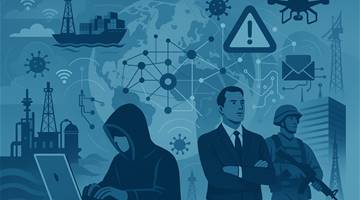

Hybrid threats strike states, institutions and industries every day. They are coordinated actions conducted across multiple domains and kept below the threshold of open conflict. They combine cyberattacks, information interference, economic pressure, exploitation of choke points, proxy activities and grey-zone operations. Their goal is to weaken infrastructures, decision chains, public trust and economic stability.
Italy is exposed for three main reasons. It relies on energy imports. It hosts a dense network of critical infrastructures. It faces a growing information pressure aimed at influencing public opinion and social cohesion. The number of cyber incidents increases every year. In the first half of 2025 alone, 1,549 events were recorded, up 53 percent from the previous period. Healthcare and manufacturing remain primary targets. More than 40 percent of Italian maritime trade passes through Suez, which amplifies risks linked to instability in the Red Sea and surrounding regions.
Democracies often react slowly in this context. Attribution is difficult. The multidomain nature of the threat requires distributed expertise. Crises evolve simultaneously on several levels. For these reasons the ability to anticipate scenarios, reduce vulnerabilities and simulate cascading effects becomes essential.
Modeling and simulation provide direct value. They highlight structural weaknesses before adversaries exploit them. They offer a safe environment to test complex scenarios without operational risks. They merge cyber, logistic, economic, geopolitical and infrastructure data into a unified and coherent representation.
In the cyber domain simulations reproduce attacks, compromise chains, propagation timelines, impacts on critical nodes and recovery capacity. They model the behavior of ransomware inside a hospital network. They assess the robustness of a digital supply chain after a breach at an external provider. They reveal weak configurations early and support the development of adaptive, data-driven defensive postures.
In critical infrastructures simulation shows what happens when an energy node goes offline, when a logistics hub slows down or when a data center becomes unavailable. Multidomain modeling connects physical and digital effects in real time. A disruption in a gas pipeline, for example, becomes an immediate impact on industrial output, which then affects road traffic, port operations and essential services. This level of visibility supports investment planning, reinforcement strategies and redundancy decisions.
In the information and cognitive sphere simulation helps analyse disinformation campaigns, predict their spread and measure their impact on public debate. It is possible to reproduce the circulation of manipulated content, identify the audiences it reaches, estimate reactions and prepare coordinated responses before narratives influence political stability. Models also assist in designing digital resilience strategies, highlighting segments of the population that require targeted literacy efforts.
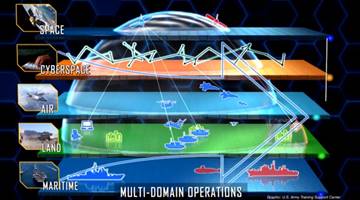
In the military domain simulation integrates space, land, sea, air and cyber into a single operational picture. It allows commands and units to train on scenarios that include GPS interference, controlled airspace incursions, unidentified drones, hostile naval manoeuvres and stress on civilian infrastructures. Each element produces cascading effects that can be observed and corrected in a controlled environment. This strengthens readiness and accelerates decision-making.
Simulation also supports geo-economic analysis. Dedicated models examine how restrictions on critical raw materials affect technological supply chains, procurement costs and national budgets. A single constraint on gallium or germanium impacts defence systems, microelectronics, telecommunications and mobility. Simulation makes these dependencies visible and helps define credible alternatives.
Overall, modeling and simulation make hybrid threats more predictable and measurable. They support decisions based on quantitative analysis. They enhance national and international response capacity. They reduce the uncertainty generated by hostile actors. They contribute to a proactive defence posture that anticipates rather than reacts.
In a world where attacks ignore borders, timelines and traditional patterns, simulation becomes a core security asset. It transforms complexity into readable scenarios. It transforms vulnerabilities into operational choices. It transforms scattered data into strategic awareness.