
In the aerospace and defense sector, modeling and simulation are evolving into a data driven, continuously updated simulation integrated as a core element of command and control. Simulation no longer supports decisions from the outside. Real world data flows directly into models and keeps them aligned with ongoing operations. This shift responds to multi domain scenarios where decision quality depends on the ability to observe, assess and react while events unfold.
For years, modeling and simulation mainly served design validation and training needs. Scenarios remained static and detached from operational reality. This approach no longer fits environments shaped by hybrid conflict, rapid escalation and strong interdependence among domains. Decision cycles now require simulation environments able to evolve at the same pace as the operational context.
Real world data represents the enabling factor of this transition. Sensors, operational platforms and communication networks continuously update the simulation layer. The gap between modeled behavior and real behavior narrows. Simulation becomes part of the operational loop and supports dynamic assessment, not limited to early planning or post event analysis.
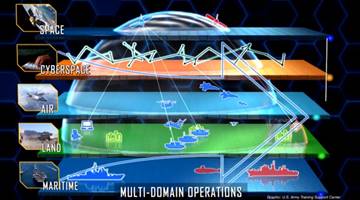
This approach is critical in multi domain operations, where underwater, maritime, land, air and space domains remain tightly coupled. Actions in one domain generate immediate effects in others. Without a continuously updated representation, these effects remain fragmented or invisible. Data driven simulation maintains a coherent operational picture and supports command and control across domains.
The OPEX TASK (first and second edition) exercise conducted by the Marina Militare Italiana provides a concrete reference. The exercise focused on critical infrastructure protection and cross domain integration. Simulation environments updated with operationally consistent data supported option comparison and assessment of indirect effects linked to command decisions.
In the underwater domain, continuous data integration is essential. Acoustic communication depends on environmental parameters that change over time and space. Temperature, salinity and seabed morphology directly affect signal propagation. Updated environmental data keeps simulation aligned with reality and supports estimation of link quality, identification of viable operational windows and assessment of resilience under disturbance or interference.
Hybrid warfare increases the strategic relevance of the underwater domain. Submerged infrastructures host cables, sensors and critical nodes with limited visibility. Data driven simulation supports preventive protection by enabling early evaluation of vulnerabilities and impact propagation before operational degradation occurs.
In the maritime domain, complexity stems from the overlap of civilian traffic, military activity and ambiguous behavior. AIS, radar and electro optical sensors feed awareness models with continuous updates. Near real time simulation supports correlation, pattern recognition and uncertainty reduction. Command decisions benefit from improved clarity in environments marked by informational noise.
The land domain links physical operations with the digital layer. Ports, bases and command centers depend on electromagnetic and communication infrastructures. Real world data supports simulation of interference, disruption and hybrid actions. Updated models reveal how localized events propagate across domains and enable early evaluation of countermeasures.
In the air domain, compressed timelines make continuous updates mandatory. Crewed aircraft, unmanned systems and air defense interact with minimal margins for error. Data driven simulation supports assessment of radar saturation, electronic disturbance and system response, while preserving coherence with land and maritime operations.
The space domain completes the multi domain structure. Earth observation, navigation and satellite communications enable operations across all other domains. Degradation at space level directly impacts land, sea and air operations. Continuous data integration updates models of coverage, resilience and interference, supporting command and control awareness of critical dependencies.
Within this operational framework, data driven and continuously updated simulation delivers concrete benefits. Decision quality improves through alignment with reality. Uncertainty decreases as cross domain effects become visible before escalation. Response times shorten through rapid evaluation of alternative courses of action. Resource efficiency improves by reducing reliance on costly physical testing. Critical infrastructure protection strengthens through early identification of vulnerabilities. In multi domain and hybrid contexts, simulation becomes an operational asset and a force multiplier, transforming data into actionable command insight.